Winner of the Latvian Startup Awards 2025 in the Impact Category! We are proud to announce that ProtiumTech
Hydrogen on demand. Electricity on better terms.
Membrane-free decoupled water electrolysis for flexible on-site hydrogen production
Temporally separated hydrogen and oxygen production, eliminating the need for a gas-separating membrane
Separates oxygen evolution and REDOX charging from hydrogen production through two sequential electrochemical cycles
Compact stack architecture with REDOX electrode assemblies redesigned from 132 to just 10 components
Integrated electrode assemblies with reduced component count per cell from 132 to 10
Simple architecture without high-temperature processes

38.8 kWh/kg H₂ consumed during REDOX charging, allowing the energy-intensive stage to be prioritised during lower-cost electricity periods

Designed for frequent start-stop cycles to respond to electricity prices, renewable energy availability and hydrogen demand

High-power REDOX charging takes place during lower-cost electricity periods, while hydrogen is produced in a separate, lower-power discharge stage

Align H₂ production with actual demand to minimise storage requirements, reducing both system footprint and capital costs
Water electrolysis consists of two electrochemical half-reactions: the oxygen evolution reaction (OER) and the hydrogen evolution reaction (HER). In conventional water electrolysis, these reactions occur simultaneously, requiring a membrane or separator to prevent hydrogen and oxygen from mixing.
ProtiumTech’s membrane-free decoupled water electrolysis technology separates oxygen and hydrogen production in time. Both gases are produced sequentially on the same working electrode through two alternating electrochemical cycles, enabled by an auxiliary solid-state REDOX electrode.
The electrolysis cell consists of a cell body filled with an electrolyte, in which the working electrode and the auxiliary WO₃-based REDOX electrode are immersed.
1. Oxygen Evolution Reaction (OER) – Charging Cycle
During the OER stage, the positive terminal of the power supply is connected to the working electrode, while the negative terminal is connected to the auxiliary REDOX electrode.
When the required potential is applied, oxygen is generated at the working electrode. Simultaneously, protons are intercalated into the WO₃-based auxiliary electrode, reducing WO₃ to HₓWO₃ and effectively storing protons within its solid-state structure.
As a result, only oxygen gas is produced during this stage, while the auxiliary REDOX electrode becomes charged.
2. Hydrogen Evolution Reaction (HER) – Discharging Cycle
During the HER stage, the polarity of the power supply is reversed. The working electrode becomes negatively polarised, initiating hydrogen evolution, while the auxiliary electrode undergoes oxidation.
The stored protons are released from the HₓWO₃ structure through deintercalation and participate in hydrogen production at the working electrode. The auxiliary electrode consequently returns to its initial WO₃ state.
As a result, only hydrogen gas is produced during this stage, while the REDOX electrode is discharged.
3. Continuous Cyclic Operation
The process operates through a repeating charge–discharge sequence:
OER: Oxygen is released, and the auxiliary REDOX electrode is reduced and charged.
HER: Hydrogen is released, and the auxiliary REDOX electrode is oxidised and discharged.
Once the HER stage is completed, the REDOX electrode is ready for the next charging cycle.
By separating hydrogen and oxygen evolution into successive electrochemical stages, the system eliminates the need for a gas-separating membrane.
Furthermore, the two stages have different electrical power requirements, allowing the energy-intensive OER stage to be prioritised during periods of lower electricity prices or higher renewable energy availability, while hydrogen can be produced during the lower-power HER stage.
This operating principle enables greater flexibility in electricity consumption and hydrogen production, including repeated start-stop operation and improved alignment with industrial hydrogen demand.
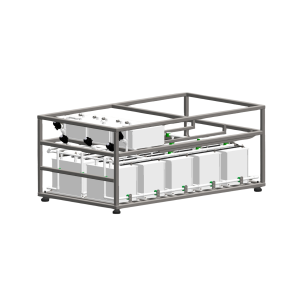
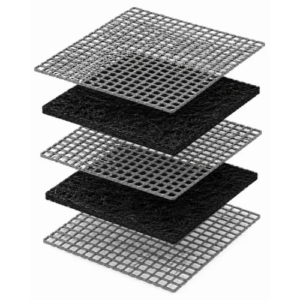
A compact, modular electrolyser stack integrates five REDOX electrode assemblies and four catalyst electrodes within each sealed polymer housing. Multiple electrode boxes are electrically connected in series to form the stack.
Redesigning the REDOX electrode assembly reduced its component count from 132 to just 10 while maintaining the same power output, simplifying manufacturing and assembly while supporting future scalability.
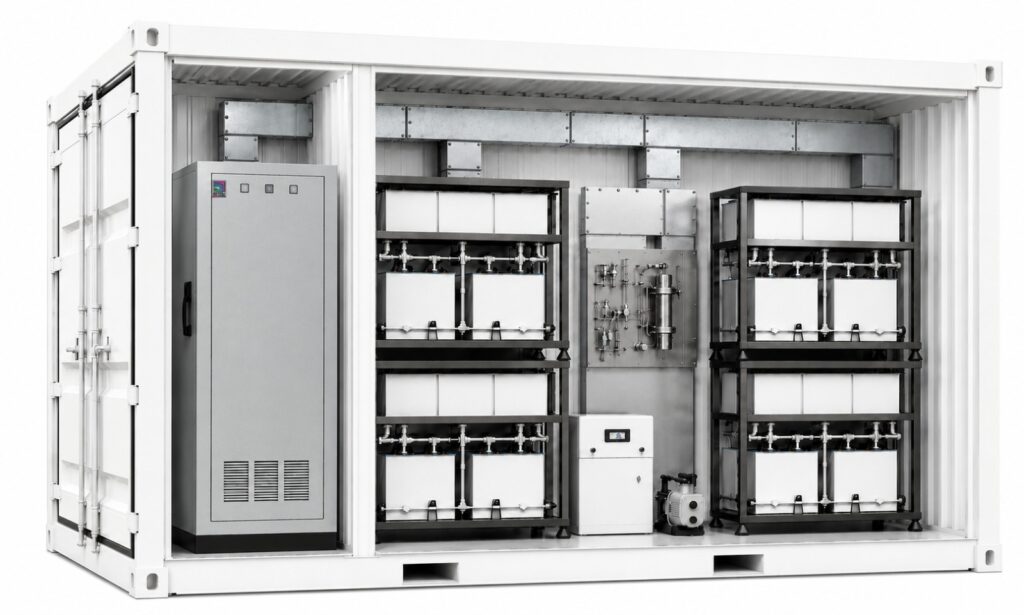
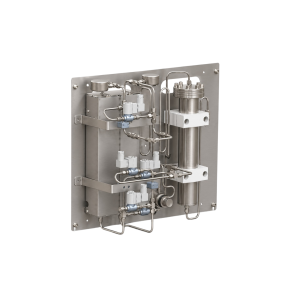
A compact, integrated gas-management system designed for membrane-free decoupled electrolysis combines automated gas-flow control, vacuum purging between OER and HER cycles, cooling, coalescing filtration, catalytic deoxygenation and TSA drying.
Its modular architecture simplifies integration, reduces auxiliary equipment requirements and enables hydrogen purification to a target purity of up to 99.999%.
In-house manufacturing of WO₃-based REDOX electrodes combines proprietary water-based slurry formulation, carbon-felt impregnation, drying and thermal treatment, replacing conventional NMP-based solvent processing.
These electrodes enable reversible proton storage and release during OER and HER cycles. Full control over materials and manufacturing supports performance optimisation, consistent electrode quality and future production scaling.
Winner of the Latvian Startup Awards 2025 in the Impact Category! We are proud to announce that ProtiumTech
ProtiumTech Selected for Fundación Repsol’s Fondo de Emprendedores Program securing 120k convertible loan! ProtiumTech is proud to announce
ProtiumTech Completes Plug and Play Batch #3 and Secures Investment! On April 10th, ProtiumTech participated in the Plug
ProtiumTech clinched 4 awards at TechChill 2025! On February 7, 2025, ProtiumTech celebrated a major milestone at TechChill
ProtiumTech’s Latest Breakthrough: Improved Efficiency and Hydrogen Production Volume ProtiumTech is proud to introduce a groundbreaking advancement in
ProtiumTech is a Latvian deeptech and cleantech startup established in 2023, focused on developing membrane-free decoupled water electrolysis systems for efficient and on-demand green hydrogen production. We’re combining advanced electrochemistry, materials science, and engineering to address one of the key challenges in the hydrogen economy – reducing the cost and improving the operational flexibility of green hydrogen production.
Our technology platform combines electrochemical innovation with in-house materials development, electrode manufacturing, modular stack engineering and integrated gas-management systems.